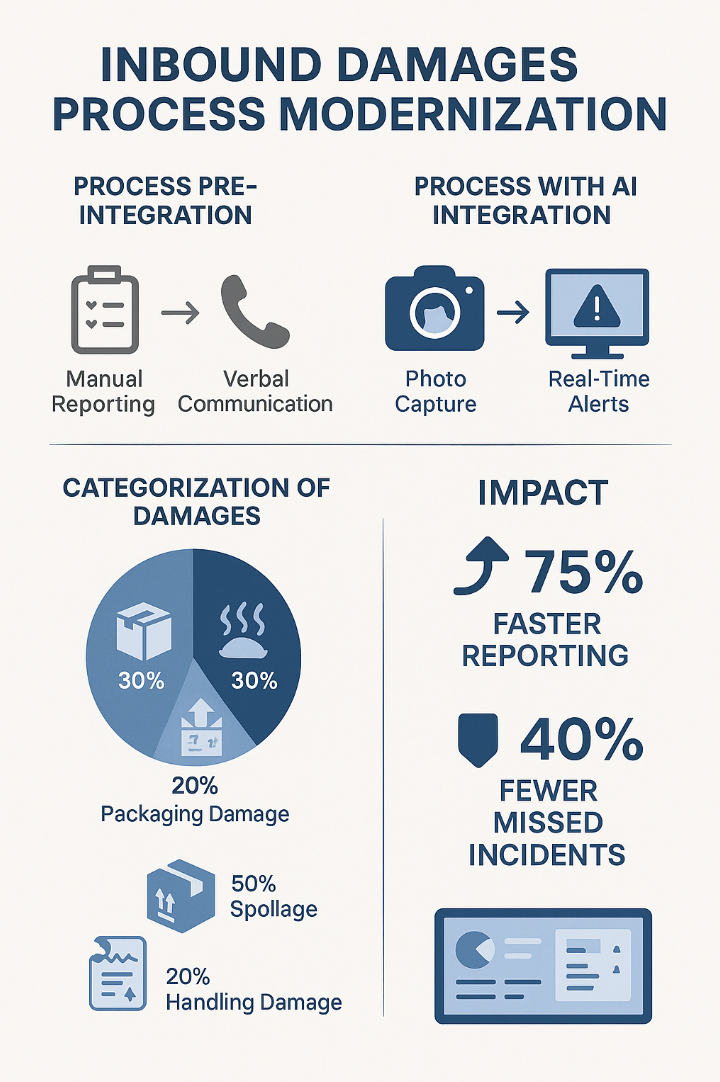
AI-Powered Damage Detection & Governance System
Real-Time Inbound Damage Classification & Escalation Pipeline
Overview
Led the design and deployment of an AI-powered damage detection and reporting system for inbound logistics, transforming manual, delayed reporting into a real-time, governance-aligned decision pipeline.
The system combined computer vision and anomaly detection with a role-based reporting interface, enabling rapid identification, classification, and escalation of shipment damages while maintaining auditability, accuracy, and compliance.
This work operationalized computer vision and anomaly detection within a governance-aligned pipeline, enabling scalable, auditable, and human-validated decision-making.
Problem
Inbound damage reporting relied on manual documentation and delayed workflows, resulting in:
Reporting delays ranging from hours per incident
Inconsistent damage classification and documentation quality
Limited visibility into real-time operational issues
High risk of SLA non-compliance and customer dissatisfaction
Lack of auditability and governance over damage assessments
These challenges made it difficult to ensure consistent, accurate, and defensible reporting at scale.
Approach
AI Detection & Classification Pipeline
Built an AI-powered detection and classification pipeline designed for real-time operational use, human validation, and governance compliance.
Integrated computer vision models trained on historical image datasets
Implemented anomaly detection to identify non-standard damage patterns
Enabled real-time alerts and classification scoring
Human-in-the-Loop Validation
Balanced automation with human oversight to ensure accuracy and accountability.
Used AI for initial detection and severity scoring
Required human validation for final confirmation and escalation
Designed workflows to support rapid review without slowing operations
Governance & Auditability
Embedded governance, auditability, and model accountability directly into the system architecture:
Implemented confidence scoring thresholds to manage false positives
Designed audit trails for all model decisions and user interactions
Conducted bias and data quality reviews to ensure consistent performance
Workflow Integration & Adoption
Aligned the system with real-world operational workflows.
Conducted multi-site workflow analysis to map current-state processes
Designed role-based interfaces for dock workers, supervisors, and QA managers
Led usability testing and training to support adoption and scalability
Key Tradeoffs
Automation vs. Human Verification
Sensitivity vs. False Positives
Explainability vs. Model Complexity
Scalability vs. Data Quality Control
Decisions prioritized accuracy, auditability, and trust over fully automated optimization.
Outcome
Reduced reporting time from hours to under 2 minutes per incident
Increased damage classification accuracy by 88%
Improved SLA compliance and customer trust through consistent reporting
Delivered a governance-compliant AI pipeline with auditability and explainability
Enabled scalable, real-time damage monitoring across operations
Key Capabilities Demonstrated
End-to-End AI System Design (Computer Vision + Workflow Integration)
Human-in-the-Loop Decision Architecture
AI Governance & Auditability Design
Real-Time Operational AI Implementation
Cross-Functional AI Product Leadership