Cognitive Adaptive Learning System (CALS): A Human-Centered Framework for Readiness, Engagement, and Independent Thinking
Overview
Developed Cognitive Adaptive Learning System (CALS)
A human-centered framework designed to improve readiness, engagement, and independent thinking in AI-supported study environments.
This work introduces a behavioral and governance-driven framework that structures how students interact with AI, ensuring that AI supports learning without replacing reasoning.
The system operationalizes principles from human–computer interaction, cognitive psychology, and education research into measurable behavioral signals and adaptive system logic.
Problem
AI is increasingly integrated into learning environments, yet most systems:
prioritize answer generation over learning process
allow unrestricted AI interaction, increasing dependency risk
fail to account for student readiness, attention, and engagement
rely on self-reported understanding rather than demonstrated learning
lack governance mechanisms to prevent over-reliance and automation bias
These gaps create conditions where AI may improve efficiency while unintentionally weakening independent thinking and long-term learning outcomes.
Framework
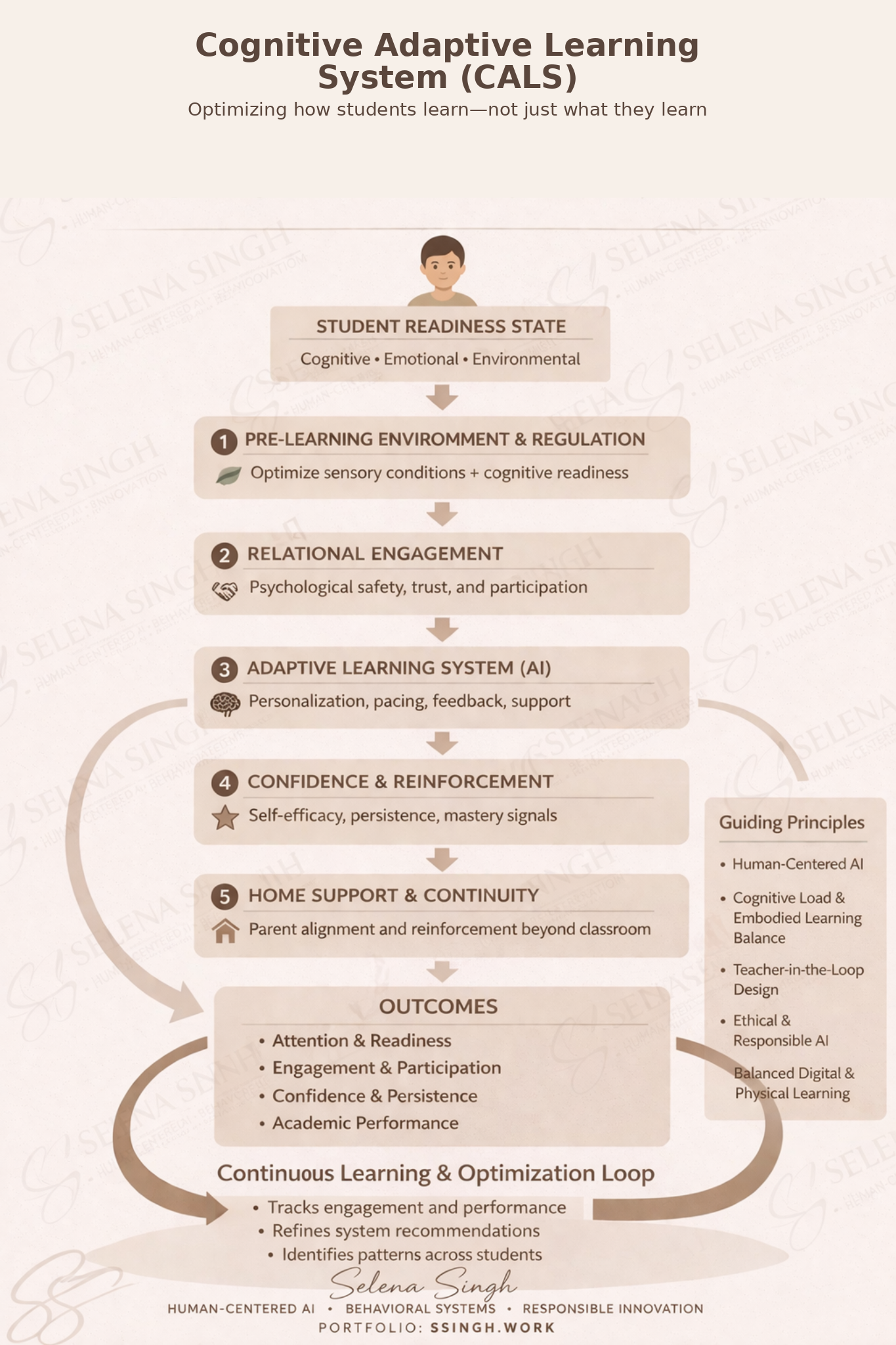
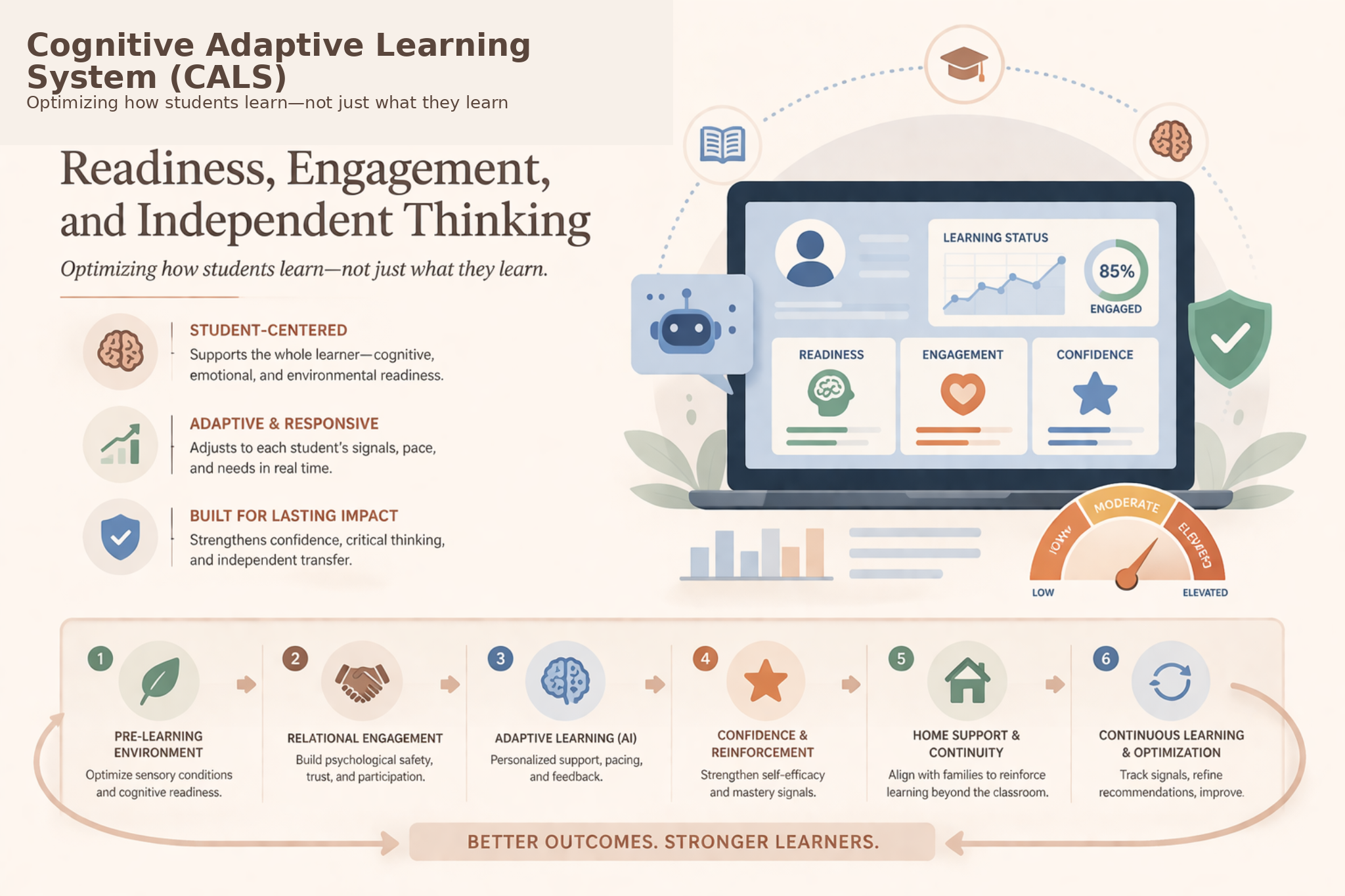
Developed a human-centered AI learning framework that models learning as a behavioral system rather than a purely instructional process.
The framework is structured across:
Readiness Activation – preparation of cognitive and emotional conditions for learning
Relational Engagement – support for participation and psychological safety
Adaptive Learning with AI – structured AI-assisted support based on context
Critical Thinking with AI – guided interaction to improve question quality and evaluation
Confidence & Reinforcement – support for persistence and engagement
Independent Thinking & Transfer – validation of understanding beyond AI assistance
Continuous Feedback & Governance – adaptive system behavior based on observed signals
This framework ensures that AI interaction is shaped by human learning conditions, not just content delivery.
Approach
System Design & Simulation
Designed and implemented a structured learning system using simulated student inputs, including:
readiness, confidence, and engagement levels
task complexity
baseline prompting behavior and transfer performance
Readiness Activation Modeling
Simulated a pre-learning activation phase to improve cognitive readiness and reduce overload:
modeled increases in readiness, confidence, and engagement
incorporated flexible student behavior rather than rigid compliance
aligned system flow with real-world learning conditions
Structured AI Interaction
Developed a constrained AI interaction model:
adaptive prompt support levels based on readiness and task complexity
pre-thinking requirement before prompting
evaluation of AI responses rather than passive acceptance
Critical Thinking & Behavioral Evaluation
Tracked how students interact with AI:
prompt efficiency and redundancy
response evaluation behavior
intentional vs reactive prompting patterns
Independent Thinking & Transfer Validation
Required students to demonstrate understanding beyond AI:
explanation in their own words
application of knowledge to new problems
This layer serves as the system’s primary validation mechanism for learning.
Governance & Bias Mitigation
Embedded governance directly into the system:
multi-signal evaluation (not reliant on self-report or AI output alone)
behavioral validation through observed interaction patterns
no rigid labeling or fixed ability categorization
transparent system signals with human-in-the-loop interpretation
Key Tradeoffs Identified
Identified critical system-level tradeoffs shaping learning outcomes:
Structured Support vs. Over-Restriction
AI Assistance vs. Independent Thinking
Efficiency vs. Cognitive Engagement
Personalization vs. Dependency Risk
Findings
Readiness activation improved baseline engagement, confidence, and task initiation
Structured prompting reduced redundant AI interaction and improved question quality
Students demonstrated stronger independent explanation and transfer performance
Higher-quality AI interaction correlated with lower dependency scores
Multi-signal evaluation revealed gaps between perceived and actual understanding
These findings show that structuring AI interaction improves learning outcomes without removing access to AI.
Outcome
Developed a scalable human-centered AI learning system grounded in behavioral and cognitive principles
Designed a repeatable framework for evaluating and structuring AI-supported learning environments
Demonstrated how AI can be integrated without degrading independent thinking
Established a governance-aware approach to mitigating dependency and automation bias in education
Key Capabilities Demonstrated
AI Governance & Responsible AI Design
Behavioral Systems Modeling in Learning Environments
Human–AI Interaction Design (HCI)
Educational Systems Strategy
Adaptive System Design & Evaluation
Cognitive & Behavioral Signal Analysis